
I am teaching a graduate creative nonfiction class this semester, and an outcome of this course is that students will have a draft that they have revised three times and they will send it out to places for publication. I am writing this blog entry for my students, and I am going to make part one and two. Part two will go out next week. Part one of this series will be basics for how to get ready to submit your creative nonfiction essays for publication in literary magazines.
Step One: Get Ready
I use a spreadsheet to track my submissions. I am not the best at spreadsheets, but it does help me to remember where I submit stuff. Not all litmags use submittable, so you’ll want to keep track of where your stuff is submitted, so you don’t run into having two acceptances at once.
And format your manuscript very simply with double-spacing, a simple font, Here’s an amazing and interactive example of how to format your manuscript for publication, and it’s openly licensed.
Step Two: Do Some Research
I like to use Chill Subs and the Poets and Writer’s database to find journals that are accepting submissions. There’s also Duotrope which costs about $5 a month, and I have a subscription, but I might cancel it. I haven’t used it in months. It does have good information though, like how long it takes magazines to respond, and you can track your submissions there. These sites will tell you when magazines are accepting submissions, but sites can be wrong or a magazine can decide to close their open submission period if they have more works than they can possibly evaluate.
Another piece of criteria you might want to consider if you are sending out your work is the literary merits of the magazine, especially for writers who will want to consider entering the job market soon. If you want to publish somewhere with heavy hitting authors, search around on the magazine’s website to see who else they have published, so you can identify whether this magazine is right for you.
Publisher’s Marketplace is also a great site if you are submitting a book-length manuscript. It has a lot of helpful details, and you can learn about book deals, agents, editors, and the publishing industry in general. I really like the website and I also have a subscription to this site. It’s about $25 a month. You definitely don’t need this site to submit to litmags though.
Once you identify six literary magazines or so to submit your work to, log them in your spreadsheet, and get ready to submit.
Step Three: Write a Cover Letter
Make it simple. Don’t be cute. Don’t do anything strange that might make them not want to open your essay. Here’s a simple letter. The cover letter basically falls under the category of office writing. Save the descriptive language for your submission.
Dear Editors,
Please consider my personal essay ‘My Father’s Friends’ for publication in Baltimore Review. This nearly 4,500 word essay is a chapter from my manuscript. I wrote about this life event for the NPR show This American Life (TAL). I started developing it into a prose piece while working on my manuscript, which is a book-length memoir.
This piece has more descriptions, characterization, and backstory than the original. It also has a different angle. This is a simultaneous submission. Here’s the URL for the TAL story: https://www.thisamericanlife.org/346/home-alone/act-three
Besides TAL, my writing has appeared or is forthcoming from Creative Nonfiction, Hayden’s Ferry Review, Sonora Review, Cutbank, and others. I am a Latinx writer, librarian, and assistant professor from Albuquerque.
Thank you for considering my story.
Jennifer
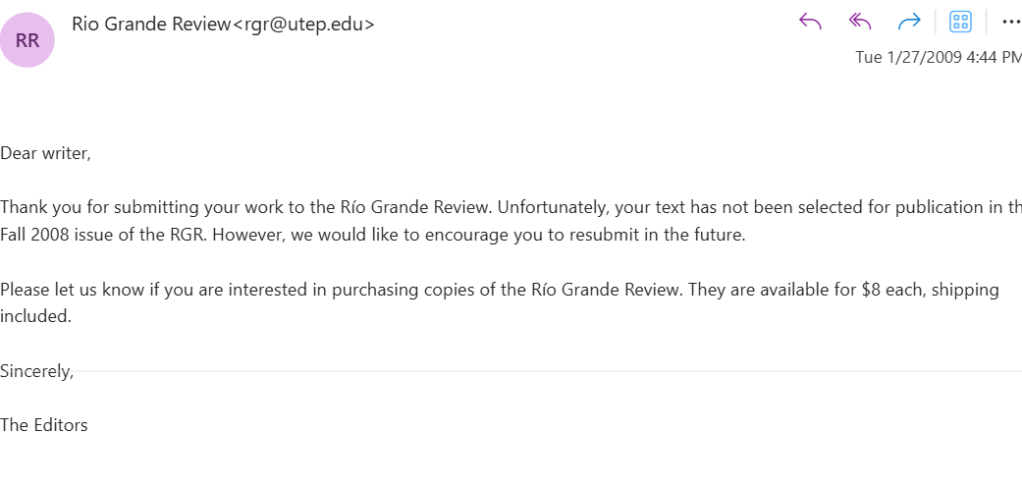
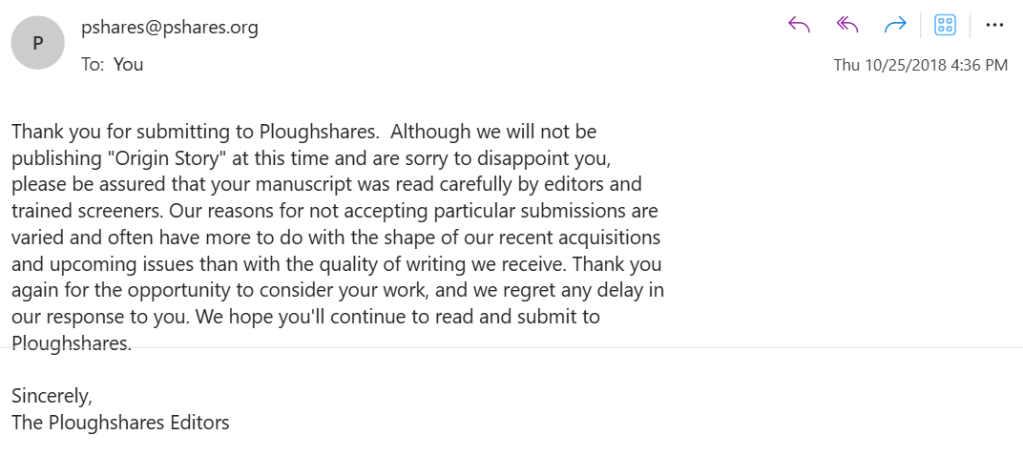
Next week, I will finish this blog series by wrapping up a few more pointers on sending out work, and I will go over why you should not be discouraged by rejections. They are part of the process. As a side note and a teaser, I am including some of my own personal rejections and acceptances.
A nice form rejection
An even nicer form rejection
An acceptance!

 Jennifer Jordan
Leave a comment